
The first your neighbors hear about your dock may be a letter with your name and address on it, a description of what you intend to build, and a drawing showing exactly where it will sit in the water relative to their shoreline.
That is not a leak or a courtesy. It is a requirement, and the federal regulation that governs it is specific about what the letter contains, who receives a copy, how long they have to respond and what the district engineer must do with what comes back.
Not every dock reaches that point, which is worth saying before anything else. The regulation lays out three routes to an authorization and only one of them is advertised. But a project that lands on the advertised route tends to get there without warning, and the owners involved arrive with two questions. Can the neighbors stop it? And if not, what exactly can they do?
The answers are more interesting than either “it’s just a formality” or “one objection kills it”, and both of those are things people are told.
Last reviewed: 8 October 2026 against 33 CFR Parts 325 and 327 as published in the 2024 Code of Federal Regulations. Federal regulations are amended; confirm the current text and your district’s procedures before relying on any timeline here.
Three ways the Corps can authorize a dock, and only one of them is public
The Department of the Army issues permits in two broad forms, individual permits and general permits, and the difference decides whether your project is ever advertised.
A general permit covers a whole category of activity in advance. Where a regional permit has been issued, the regulation is blunt about the consequence: individual activities falling within those categories “do not have to be further authorized by the procedures of this regulation.” The public notice happened once, for the permit itself, not for your dock. Nationwide permits work the same way, and the notice the Corps publishes for them is governed by a different part of the regulations altogether.
A letter of permission is an individual authorization processed through an abbreviated procedure. It still includes coordination with federal and state fish and wildlife agencies and a public interest evaluation, but it happens “without the publishing of an individual public notice.” Under Section 10 of the Rivers and Harbors Act, a letter of permission is available where the district engineer judges the proposed work would be minor, would not have significant individual or cumulative impacts on environmental values, and “should encounter no appreciable opposition.”
That third criterion is the hinge of the whole subject. The expectation of opposition is not something the Corps weighs at the end of the process. It is one of the things that decides which process you get.
A standard individual permit is the one that goes public. The regulation defines it as a permit “which has been processed through the public interest review procedures, including public notice and receipt of comments.”
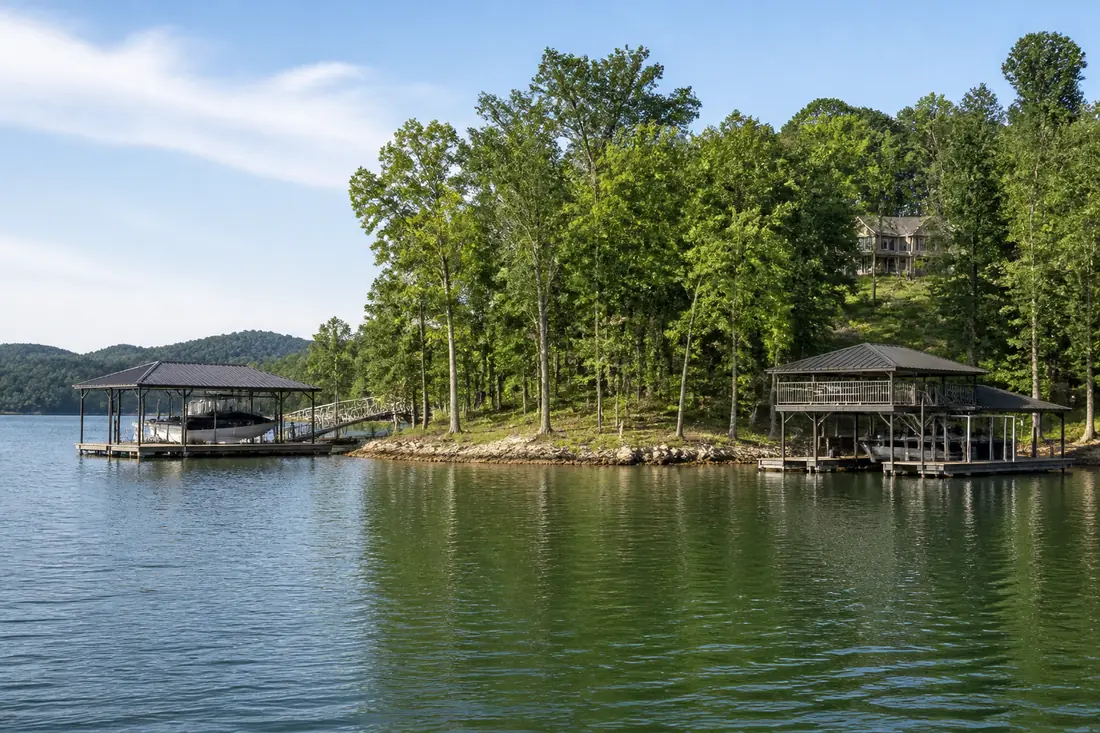
Those three criteria are the ones to read a project against. A dock that is modest in scale, sits where docks already sit, and raises no individual or cumulative environmental question is being measured against a test it can meet. A dock that is unusually large, unusually placed, close to something sensitive, or already the subject of a dispute is being measured against the same test and failing a part of it. Our guide to TVA Section 26a approval covers the separate state-level agency review that runs alongside all of this.
What the notice says, and who gets a copy
Section 325.3 lists seventeen items a public notice should contain. A handful of them matter to a homeowner more than the rest.
The notice includes the name and address of the applicant and the location of the proposed activity. It includes a brief description of the activity, its purpose and intended use, with enough detail about the structures involved “to generate meaningful comments.”
And it includes a plan and elevation drawing showing the site location and the character of the proposed work, including, in the regulation’s own words, “the size relationship of the proposed structures to the size of the impacted waterway and depth of water in the area.”
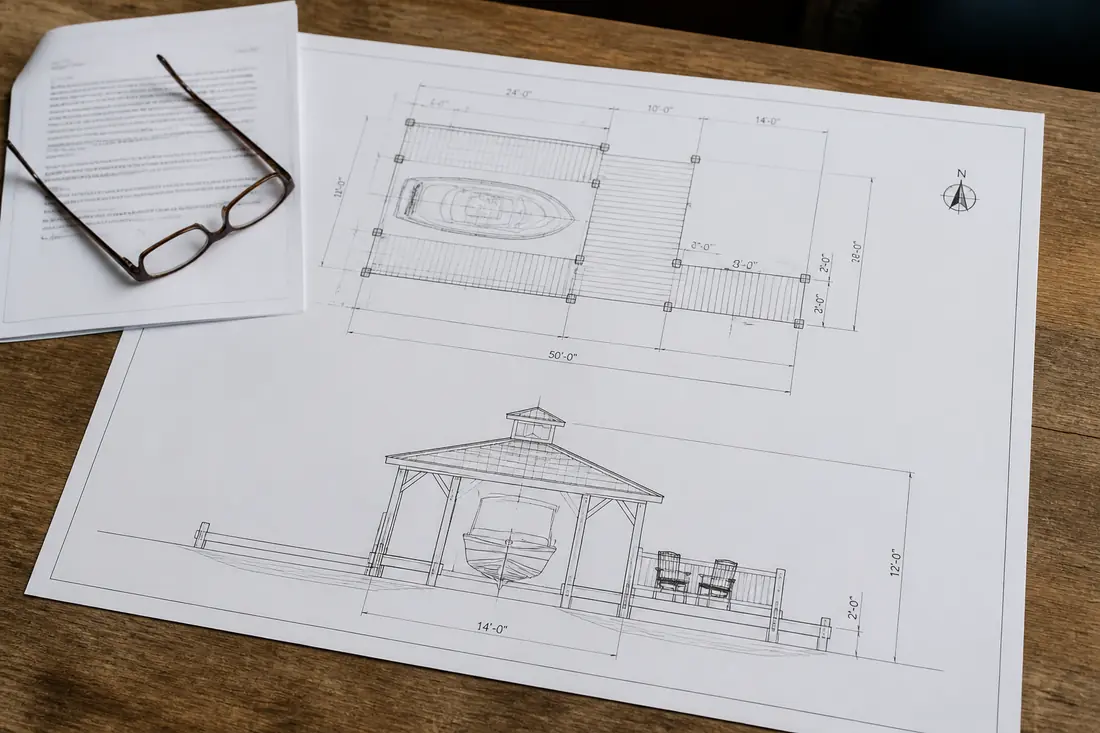
The drawing you prepare for the application is therefore the drawing your neighbors read. That is a reason to understand it properly before it goes anywhere, and we have written separately about what a dock permit drawing is actually approving.
Then the distribution list, which is longer than most people expect. Notices are posted in post offices or other appropriate public places near the site, and sent to the applicant, to appropriate city and county officials, to adjoining property owners, to appropriate state agencies, to appropriate Indian Tribes or tribal representatives, to concerned federal agencies, to shipping, business and conservation organizations, to River Basin Commissions, to local news media and to any other interested party.
Copies go further still: to anyone who has asked to be sent public notices, to the U.S. Senators and Representatives for the area, to the Fish and Wildlife Service, the National Park Service, the EPA regional administrator, the National Marine Fisheries Service, the head of the state fish and wildlife agency, the State Historic Preservation Officer and the Coast Guard district commander.
A private dock does not usually interest most of that list. The point is that the mailing is not discretionary and not selective.
The clock, in calendar days
Section 325.2(d) sets out the timetable, and one detail at the end of it is worth knowing up front: “The time requirements in these regulations are in terms of calendar days rather than in terms of working days.”
The notice goes out within 15 days of the Corps receiving all the information the applicant is required to submit. The regulation is pointed about not waiting for perfection elsewhere: issuance of a public notice “will not be delayed to obtain information necessary to evaluate an application.”
The comment period runs between 15 and 30 days from the date of the notice. It “should not be more than 30 days nor less than 15 days”, and before setting anything shorter than 30 the district engineer must consider four things: whether the proposal is routine or noncontroversial, mail time and the need for comments from remote areas, comments received on similar proposals, and whether a site visit is needed.
It can be extended by up to another 30 days where that is warranted.
The decision is due within 60 days of a complete application. That deadline has six listed exceptions: where it is precluded as a matter of law, where the case must be referred to higher authority, where the comment period is extended, where the applicant does not submit information or comments on time, where processing is suspended at the applicant’s request, and where information the district engineer needs cannot reasonably be obtained inside the 60 days.
The regulation works one of those through itself: “if the comment period is extended by 30 days, the district engineer will, absent other restraints, decide on the application within 90 days of receipt of a complete application.”
One more timing provision cuts toward the applicant. If the district engineer asks for something, the applicant gets a reasonable period “not to exceed 30 days” to respond, and the request may come by certified letter stating that a failure to respond means the application will be treated as withdrawn or decided as it stands. That is a deadline worth putting in a calendar rather than a drawer.
What actually happens to an objection
This is the part most often misdescribed in both directions.
The district engineer “will consider all comments received in response to the public notice.” They are acknowledged where appropriate and “made a part of the administrative record of the application”, which means they persist and are reviewable rather than being read once and discarded.
Then three provisions that together describe the real weight of an objection.
Volume is handled, not counted. “Comments received as form letters or petitions may be acknowledged as a group to the person or organization responsible for the form letter or petition.” A petition with 300 signatures enters the record as a petition. It is not 300 objections, and the regulation does not convert quantity into weight.
The applicant gets to answer. Substantive comments are furnished to the applicant “at the earliest practicable time” for information and any views the applicant wishes to offer. Where the district engineer concludes he needs the applicant’s view on a particular issue to make the public interest determination, the applicant is given the opportunity to supply it. The applicant “may voluntarily elect to contact objectors in an attempt to resolve objections but will not be required to do so”, and Corps staff may be offered to attend meetings between applicants and objectors to explain the process, mediate or gather information.
Nobody votes. “District engineers will ensure that all parties are informed that the Corps alone is responsible for reaching a decision on the merits of any application.”
So an objection is neither a veto nor a vote. What it does is put a specific issue into a record that the decision has to address, and the quality of the issue raised is what determines whether it changes anything. A comment identifying a navigation hazard, an unrecorded easement or a habitat concern is doing something that a hundred comments expressing displeasure are not.
The balance the decision is actually struck on
Every public notice has to carry a paragraph describing the evaluation factors, and the regulation prescribes its wording. It is the clearest short statement of the standard a dock is judged against:
The decision whether to issue a permit will be based on an evaluation of the probable impact including cumulative impacts of the proposed activity on the public interest. That decision will reflect the national concern for both protection and utilization of important resources. The benefit which reasonably may be expected to accrue from the proposal must be balanced against its reasonably foreseeable detriments.
The same paragraph then lists what may be weighed: conservation, economics, aesthetics, general environmental concerns, wetlands, historic properties, fish and wildlife values, flood hazards, floodplain values, land use, navigation, shoreline erosion and accretion, recreation, water supply and conservation, water quality, energy needs, safety, food and fiber production, mineral needs, considerations of property ownership and, in general, the needs and welfare of the people.
Two words in there do a lot of work. Cumulative shifts the question from what your dock does on its own to what it adds to what is already there, which is how a modest structure in a crowded cove can draw more scrutiny than a larger one on open water. And considerations of property ownership is the hook that makes a boundary or easement dispute a legitimate permit issue rather than a private matter.
A hearing request is granted by default
Here is the provision that genuinely surprises people, and it sits in Part 327 rather than Part 325.
Unless the notice already says a hearing will be held, any person may request one in writing within the comment period. The request has to state “with particularity the reasons for holding a public hearing”, so a bare demand does not qualify.
On receiving such a request the district engineer may try to resolve the issues informally. Failing that, the standard is this:
Requests for a public hearing under this paragraph shall be granted, unless the district engineer determines that the issues raised are insubstantial or there is otherwise no valid interest to be served by a hearing.
Shall be granted, unless. The default is to hold it, and refusing requires a finding. That finding must be made in writing and the reasons communicated to all requesting parties.

And then the tiebreaker, which is one sentence: “In case of doubt, a public hearing shall be held.”
A hearing does not decide anything. The presiding officer, normally the district engineer, puts the requests, the supporting material, material submitted for and against, and the transcript into the administrative record, and that record is available for public inspection. What a hearing adds is procedure rather than a verdict, and the procedure has its own clock. Section 327.11(a) requires a public notice of the hearing itself, which “should normally provide for a period of not less than 30 days” before it, so interested parties can prepare. Section 327.8(g) then requires the presiding officer to allow “not less than 10 days after the close of the public hearing for submission of written comments.” Both are floors rather than estimates, and they sit on top of the schedule the application was already running on.
What the decision has to say, in writing
After the comments, the environmental documentation and any hearing, the district engineer prepares a statement of findings, or a record of decision where an environmental impact statement was prepared. It has to be dated, signed and placed in the record before final action.
Two further requirements are useful to know about.
If the district engineer decides something contrary to a state or local decision, the decision document must set out the significant national issues and explain how they are overriding in importance. A local body’s position is not binding, but departing from it has to be justified on the record.
If the permit is denied, the applicant is advised in writing of the reasons. And where a denial rests on something other than navigation or a missing state, local or federal approval, the regulation requires that the statement of findings “conclusively justify” it.
Separately, the district engineer publishes a monthly list of permits issued or denied in the previous month, identifying each by notice number, applicant name and a brief description.
The denial that never reaches a public notice
One provision reorders the sensible sequence of a dock project more than anything else in Part 325.
District engineers are authorized to deny permits without issuing a public notice or taking other procedural steps where the required local, state or other federal permits for the activity have been denied, or where the district engineer determines the activity will clearly interfere with navigation.
So if the state-level or agency approval your dock depends on has already been refused, the Corps does not need to run a comment period to tell you no. It follows that the order in which you spend money matters: establishing that the property and the project can be approved at all comes before design, and well before materials.
What the permit fee is, and what it is not
Worth stating plainly because the figures are small enough to be mistaken for a typing error. Under Section 325.1(f), the application fee is $10 where the work is non-commercial in nature and provides personal benefits unconnected to a commercial enterprise, and $100 where the purpose is commercial or industrial. The district engineer alone decides which basis applies.
Three details attached to it:
- Collection is deferred until the activity has been determined not contrary to the public interest.
- No fee is charged if the application is withdrawn at any time before the permit issues, or if the permit is denied.
- No fee applies to general permits or letters of permission, nor to time extensions, nor to transferring a permit between property owners.
The fee is an administrative charge, not a measure of the work involved. Nothing about $10 should suggest that an individual permit is a light process, and a multi-month review with a hearing in the middle of it costs the applicant time, design revisions and professional help rather than filing fees.
Five things that put a dock on the notice track unnecessarily
Designing before establishing the agency position. The most expensive drawings are the ones prepared for a structure that was never going to be approved in that position.
Surprising the adjoining owners. The regulation guarantees they will be told. A neighbor who first learns of a project from a federal notice has been handed a grievance along with the information, and the letter of permission test asks whether appreciable opposition is expected.
Leaving a boundary or easement question open. Considerations of property ownership are an express public interest factor, so an unresolved line is not a private matter the Corps will set aside.
An application that is thin. The notice must contain enough to generate meaningful comment, and a vague description invites comments asking what is actually proposed, which is a poor use of a 30-day window.
Missing the applicant’s own deadline. The 30-day response limit, with the certified letter warning that silence means withdrawal or decision as filed, is a deadline worth calendaring.
Before you apply
Find out which authorization your project needs, and whether a general permit or a letter of permission is realistically available for it. That single answer determines whether any of the rest of this applies.
Settle the agency and property questions first. Approvals that are already refused elsewhere can produce a denial with no notice and no comment period at all.
Prepare the drawing as a document strangers will read, because they will. A clear plan and elevation showing the structure against the width of the waterway and the depth of water answers most of what a reasonable neighbor would otherwise write in to ask.
Tell the adjoining owners yourself, before the mail does. You are not required to, and it is not always comfortable. It is still the cheapest available insurance against the one criterion you cannot argue with after the fact.
Diary the deadlines in calendar days. Not working days.
If you are planning a dock and are not sure which permitting track it falls on, that is the question worth answering before anything is drawn or ordered, because it decides whether any of the machinery above applies to you at all. More on what building a dock involves.
This guide explains the process in plain language and is not legal advice. The agency’s current regulations and its determination for a specific property control what is actually required.
Sources
- 33 CFR Part 325, Processing of Department of the Army Permits (2024 edition, govinfo XML). Section 325.1(f) for the $10 non-commercial and $100 commercial fees, deferred collection and the exemptions; Section 325.2(a)(1)-(3) for the 15-day completeness review, issuance of the notice and the treatment of comments, including form letters and petitions acknowledged as a group and the statement that the Corps alone is responsible for the decision; Section 325.2(a)(6)-(8) for the statement of findings, the requirement to explain a decision contrary to state or local decisions, written reasons for a denial and the monthly list; Section 325.2(d)(1)-(6) for the 15-day notice, the 15 to 30-day comment period and its four shortening factors, the 30-day extension, the 60-day decision and its six exceptions, the 90-day worked example, the applicant’s 30-day response limit and the calendar-day rule; Section 325.2(e)(1)-(2) for letters of permission, the “no appreciable opposition” test and regional general permits; Section 325.3(a), (b), (c)(1) and (d)(1) for the contents of a public notice, the prescribed public interest paragraph and its factor list, and the distribution list; Section 325.5(a)-(b) for individual permits, standard permits and letters of permission; and Section 325.8(b) for the five referral triggers and the authority to deny without a public notice.
- 33 CFR Part 327, Public Hearings (2024 edition, govinfo XML). Section 327.4(b) for the written hearing request within the comment period, the requirement to state reasons with particularity, the rule that requests “shall be granted” unless the issues are insubstantial or no valid interest would be served, and the written determination; Section 327.4(c), “In case of doubt, a public hearing shall be held”; and Section 327.5 for the presiding officer and the contents and public availability of the administrative record.