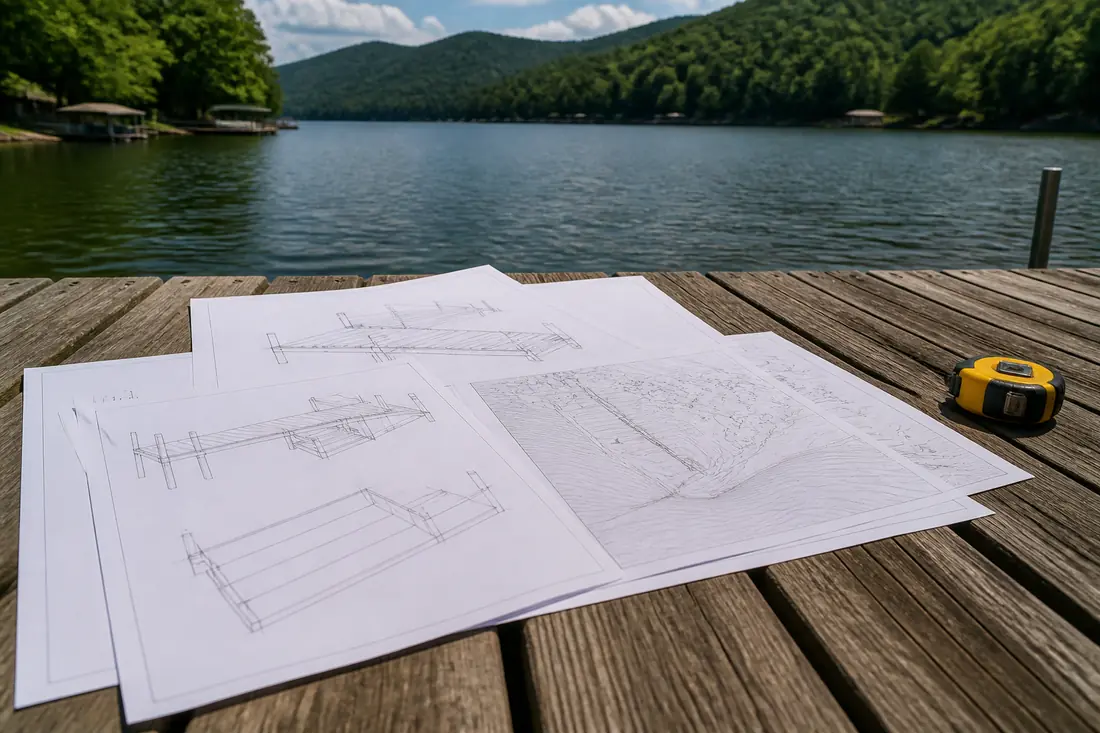
The house checks every box. The lot runs down to the water, the cove is deep enough for the boat, and there is already a weathered dock at the end of a walkway that someone built a long time ago. The hard part, it seems, is over.
Then the phrase Section 26a comes up — from the realtor, the neighbor, or a contractor who asks, a little too casually, whether the existing dock has a permit.
From that point the dock stops being a construction project. It becomes a question about who has authority over the shoreline, what the previous owner was allowed to build, and whether the dock in your head can be approved at all. Owning land that touches the water turns out not to settle any of it.
None of this is a reason to walk away from a lake property, but the order matters. Owners who sort out permitting first tend to build the dock they wanted. Owners who design first, order materials, then discover what the Tennessee Valley Authority requires tend to build something smaller, later, and twice.
The first question isn’t what kind of dock you want
Before the dock type, the slip count or the lift: does the property carry the right to put a dock in the water at all?
TVA holds land and land rights along the reservoir system, and those rights vary from parcel to parcel. The regulations are explicit that an applicant is responsible for locating the proposed facility on qualifying land, and that a TVA permit conveys no property interest of its own.
The practical version: a lot fronting the water is not automatically a lot that can have a dock. The neighbor’s dock is not evidence that yours can be built — their parcel may carry rights yours does not, or their structure may predate rules that now apply.
If the rights are not there, the dock design does not matter.
What Section 26a actually regulates
Section 26a of the TVA Act gives TVA approval authority over obstructions across, along or in the Tennessee River and its tributaries, implemented through 18 CFR Part 1304 and TVA’s Shoreline Management Policy.
TVA describes its jurisdiction as applying to two things at once: where the project is, and what kind of activity it is.
On location, the reach is wider than most people expect. Jurisdiction extends to the limits of the Tennessee River watershed — a tributary being any watercourse whose contents, if not obstructed, diverted or consumed, will ultimately flow into the Tennessee River. On the reservoirs it typically applies up to the 500-year floodplain or the upper limits of TVA flowage rights, whichever is higher.
On activity, TVA defines an obstruction broadly: any man-made physical condition that, once complete, impounds, checks, hinders, restricts, retards, diverts or otherwise interferes with the movement of water or of objects on or in the water. A dock qualifies. So do piers, boathouses and boat slips.
For a dock on Fort Loudoun, Tellico, Norris, Douglas, Cherokee, Watts Bar or Melton Hill, assume the review applies and work from there.
TVA approval is not county approval
These are separate tracks, and clearing one does not clear the other.
A Section 26a permit does not stand in for whatever Knox, Loudon, Blount, Anderson, Jefferson or Roane County requires, and a county permit does not stand in for TVA. Requirements differ by jurisdiction and change over time, so treat both as live questions rather than assuming what applied to a dock built down the shoreline five years ago.
What TVA wants to see
TVA is not approving the idea of a dock. It is approving a particular structure, of stated dimensions, in a stated position, on a specific parcel. Everything the application asks for follows from that.
The submission covers the location, a description of the project, and — the part that trips people up — accurate drawings with dimensions of all proposed facilities. That phrase is in the regulations. A sketch of the concept is not the deliverable.
For a minor facility, which is what most residential docks are, the regulations set out what the drawing has to carry:
- prepared on paper suitable for reproduction, no larger than 11 by 17 inches
- the kind of structure and its purpose or intended use
- principal dimensions, size, and location in relation to the shoreline
- the elevation of the structure above full summer pool
- the river or reservoir name, river mile, locator landmarks, and direction of flow
At least one site photograph goes in with it, showing where the proposed work sits in relation to the reservoir. TVA’s application checklist puts the consequence plainly: failure to provide required or additional information may result in an application being returned or denied.
TVA also determines whether a facility is minor or major, which affects both the review and the fee. An application is not complete until the fee has been paid.
One more item catches people whose access crosses TVA-owned shoreland: clearing vegetation there needs a Vegetation Management Plan approved by TVA in advance. The access corridor may be cleared to a maximum of 20 feet wide, and TVA designates a 50-foot-deep shoreline management zone in which no trees may be cut beyond what it has preapproved inside that corridor.
Take a hypothetical owner on Fort Loudoun who wants two slips, a covered section and a lift. That is enough to talk to a builder; it is not enough to submit. It has to become numbers and a position — overall dimensions, each slip, the covered area, how far the walkway runs, and the total footprint.
How large can a TVA dock be?
The headline figure is 1,000 square feet. Docks, piers, boathouses and all other residential water-use facilities are not to exceed that total footprint — unless the facility is in an area of preexisting development.
That exception is narrower than the shorthand suggests. The regulations define an area of preexisting development as either a subdivision recorded before 1 November 1999 in which TVA permitted at least one water-use facility before that date, or — where there is no subdivision — a location within a quarter-mile radius of another water-use facility TVA permitted before that date. Where it applies, the ceiling rises to 1,800 square feet.
It turns on dates and permit history rather than on how developed a cove looks today, and it is a determination TVA makes.
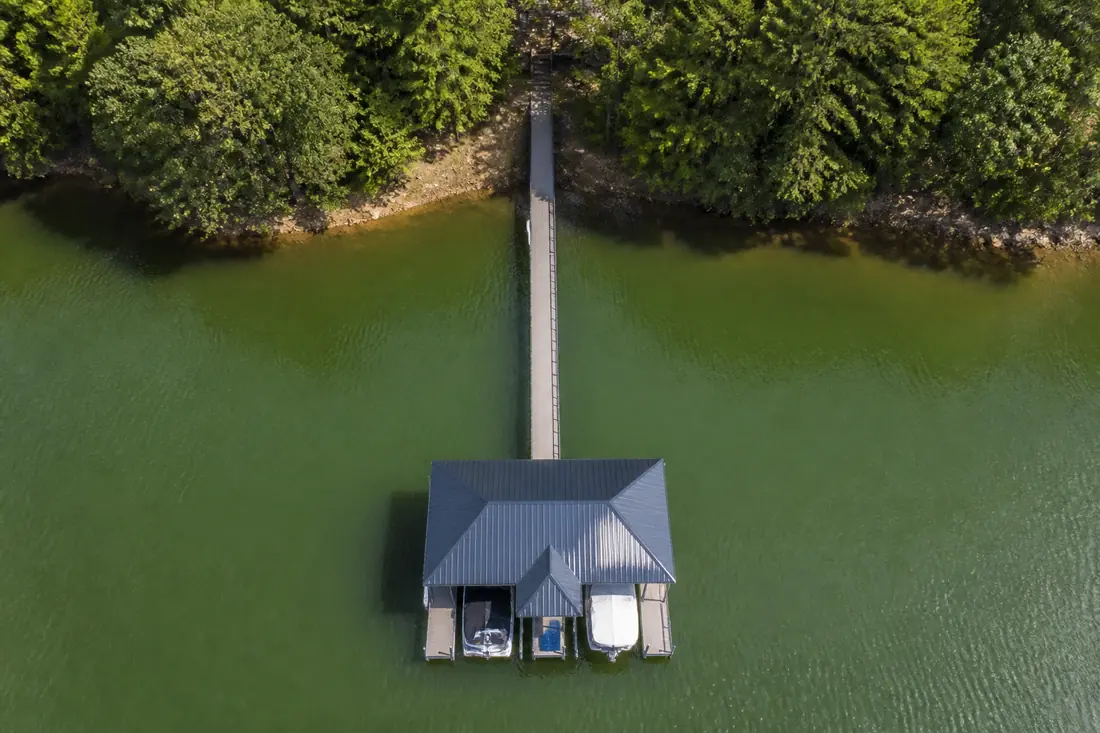
Footprint has a specific meaning: the total water surface area of a square or rectangular shape occupied by the dock, pier, boathouse or boat wells. The facility has to sit within a single rectangle or square of the applicable size, positioned at the lakeward end of the access walkway.
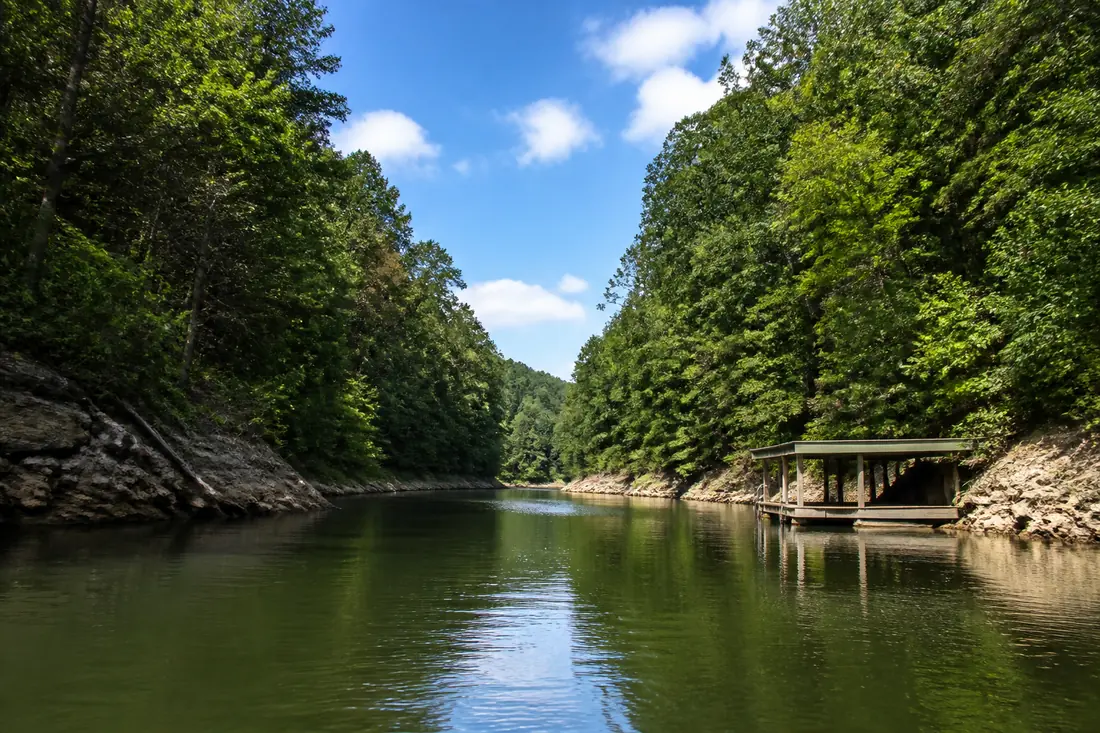
There is a separate limit on how far out a structure can go. Docks and walkways are not to extend more than 150 feet from the shoreline, or more than one-third the distance to the opposite shoreline, whichever is less.
The rules that decide where it sits, and what it looks like
Four more numbers in the same section shape a design before anything is drawn:
- Fifty feet from the neighbors’ docks. In subdivisions recorded after 1 November 1999, docks must be placed at least 50 feet from adjacent docks. Where that density cannot be met, TVA may require a group or community facility instead of an individual one — so on a narrow lot in a newer subdivision, this rule decides the project before the footprint limit gets a chance to.
- Deck height above summer pool. On the East Tennessee reservoirs the minimum is 24 inches above full summer pool. The 18-inch minimum applies only to Pickwick, Wilson, Wheeler, Guntersville and Nickajack.
- One walkway, most direct route. A dock attaches to the shore with a single walkway connecting land to the structure by the most direct route, adjoining the access corridor. Walkways over water, and internal walkways inside boathouses, are limited to six feet wide.
- Roofs. Allowed on boatslips, and over docks or piers for shade, on every reservoir around Knoxville. The exception is Kentucky Reservoir, where roofs are not allowed on fixed structures.
If the lot has less than 50 feet of frontage adjoining TVA shoreland, TVA additionally limits the overall width of what it permits, to leave room for the neighboring owners.
How long does a permit take?
Homeowners generally want to know whether the dock will be usable this season.
TVA’s published guidance gives three numbers. Processing can take up to 120 days. TVA will contact you within 30 days of a complete application to discuss the request. And TVA states it strives to issue permits for minor construction projects — the category most residential docks fall into — within 100 days.
Those are targets rather than commitments, and the clock starts from a complete submission, not from the day you first send something in. TVA describes the review itself as four steps: verifying the request meets the regulations, contacting the applicant, a site visit, then an environmental and programmatic review covering both the proposed work and any existing unauthorized activity on the property.
Because that review runs after a complete submission rather than alongside the design, a project started in spring may not be in service until the following season. The way to protect the schedule is to submit something complete.
Consultation with other agencies happens inside that window where required — under the National Historic Preservation Act or the Endangered Species Act. Permits from the U.S. Army Corps of Engineers and state agencies should be applied for alongside the Section 26a application or before it, not after TVA finishes.
What does a dock permit cost?
Two different costs sit behind that question.
The permit fee is the smaller one. Section 26a fees are set under 18 CFR Part 1310 rather than in the shoreline rules themselves, and that part establishes a range for approvals under Section 26a of $100 to $5,000.
Within that range, TVA currently publishes a flat figure: $1,000 for a minor construction project — the category that covers docks, piers and boathouses. Major construction projects such as boat ramps, marinas and dredging carry the same $1,000 initial fee with the possibility of additional charges. A request to vary the size limits is treated as an application for a major facility for fee purposes, which is worth knowing before asking for a larger dock.
Fees change. Confirm the current figure with TVA rather than budgeting from a number found online, including this one.
The larger cost is the dock. What moves it: size and configuration, whether any part is covered, water depth and reach, the bank and how access works, the lift and what it carries, the reservoir’s annual range, and how much work happens from the water.
What happens when the property already has a dock
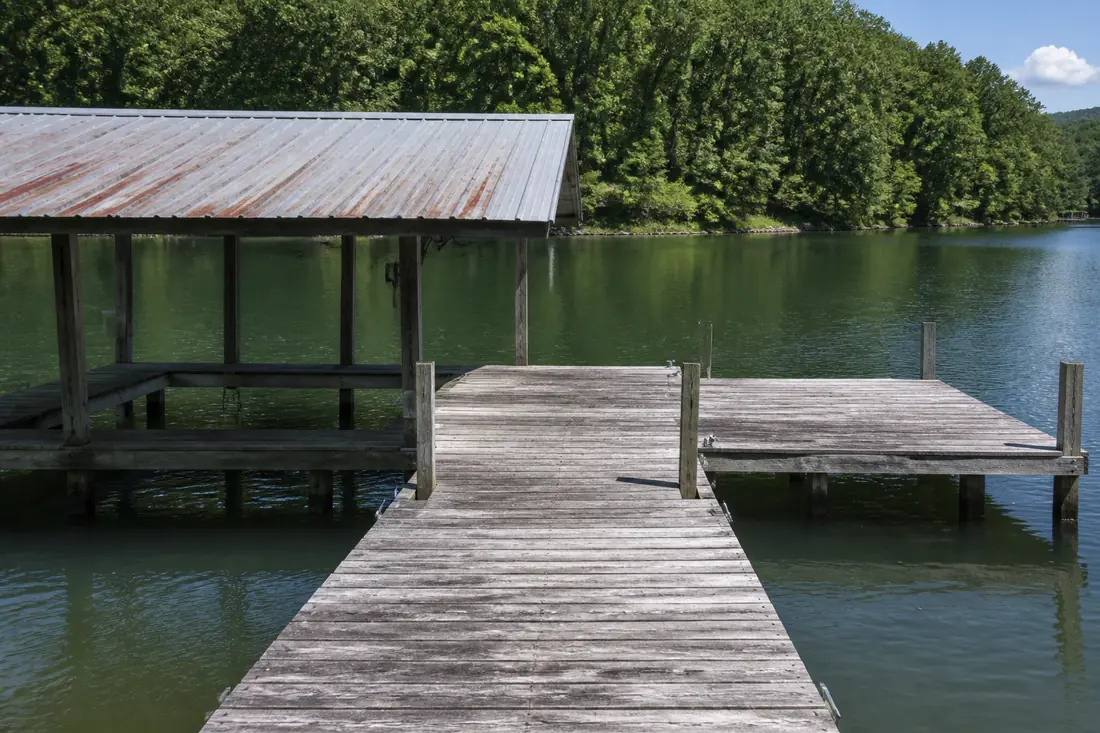
An existing structure is an advantage, but it is not a permit that travels with the deed.
Shoreline structures previously permitted by TVA are grandfathered, and may continue to be maintained in accordance with the requirements of the previous permit. Subsequent owners are not required to bring an existing, properly maintained structure up to current standards.
What does change hands is the obligation to tell TVA. When ownership of the land under a permitted facility changes, the new owner must notify TVA within 60 days. On applying, the new owner may continue using the existing facility while TVA decides whether to reissue the permit — which it does on determining that the structure is in good repair and consistent with the standards in force when the permit was first issued.
A dock extended, roofed or rebuilt by a previous owner without approval becomes the new owner’s problem, and unresolved violations or encroachments are among the things that hold up a later application.
Repair, rebuilding or modification?
Most arguments about whether a permit is needed come down to this distinction, and the regulations are more precise about it than everyday language is.
Rebuilding means replacing all or a significant portion of an approved structure to the same configuration, total footprint and dimensions as the approved plans. Same shape, same size, same position.
Structural modification means any alteration to the dimensions — length, width or height, of the structure or of enclosed and open space — or to the footprint, or to the approved plans.
Those definitions do the sorting. Replacing decking board for board, or swapping failed hardware, sits at the maintenance end. Changing the outline, enlarging the deck, adding a roof over a slip, moving the structure along the shoreline, or converting a fixed dock to a floating one are alterations to dimensions, footprint or approved plans.
Which side of the line a specific job falls on depends on what is being changed and how TVA treats it against the existing approval. That is why the question is worth asking before the demolition rather than after. A replacement should be assumed to be a permitting matter. A repair may not be.
It is also why a straight swap is sometimes the cheaper project. Rebuilding to the approved configuration stays inside a definition that already exists; growing it by four feet moves the job into a new application.
Fixed or floating docks on TVA reservoirs
Dock type is usually discussed as a preference. On these reservoirs it is closer to a site condition.
TVA operates two kinds of reservoir around Knoxville. The navigation lakes — Fort Loudoun, Tellico, Watts Bar and the run-of-river Melton Hill — are held within a relatively narrow band through the year. The tributary storage reservoirs are not: Norris, Cherokee and Douglas are drawn down hard for winter flood storage, and Douglas moves through one of the widest annual ranges on the system. TVA publishes current and projected levels for every reservoir, which is the place to check a specific lake rather than working from a remembered figure.
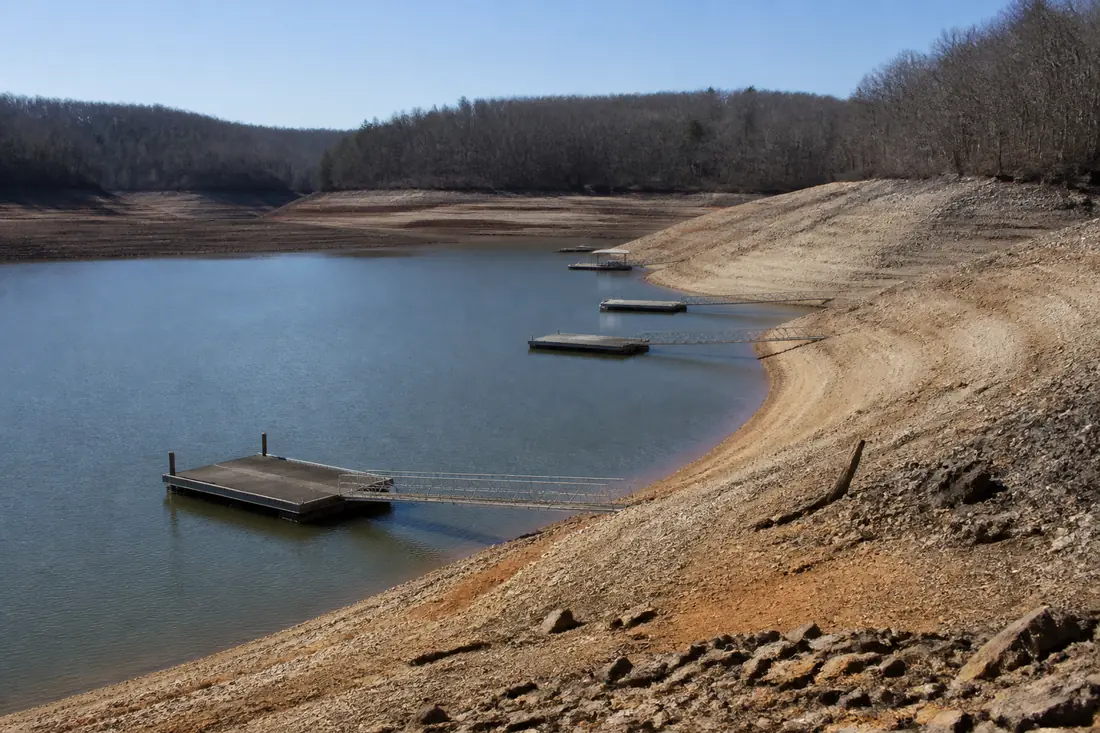
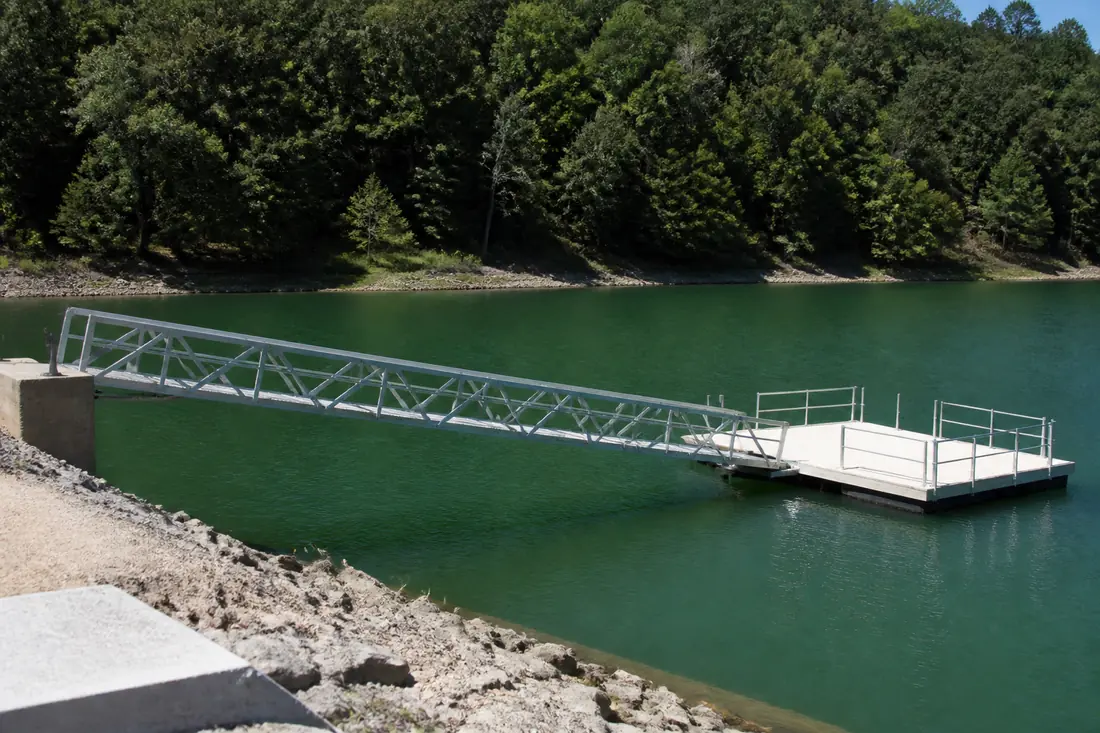
That is why floating docks and adjustable access dominate on the storage lakes. The same logic reaches the equipment — a boat lift on a reservoir with a wide annual range has a different job from one on a navigation lake.
What can delay an application
Most delay is avoidable and comes from the submission itself:
- an incomplete application, or drawings that do not match what is proposed
- changes made to the project after submission
- potential effects on sensitive resources, which can pull in consultation
- unresolved violations or encroachments on the property
- projects that additionally require a land use agreement with TVA
Buying a lake house? Check the dock rights before you close
Dock questions are cheapest to answer before the money moves. Worth establishing during the purchase:
- whether the parcel carries land rights that allow a water-use facility
- whether any existing dock holds a TVA approval, and what it covers
- whether the structure standing there matches what was approved
- whether anything has been added or altered without approval
- whether the dock you want fits the applicable footprint limit and the 150-foot and one-third-of-the-cove rules
- how far the reservoir moves through the year
The Public Lands Information Center will answer parcel-specific questions that no one else can, and is the right call before an offer rather than after.
Five mistakes that hold up dock projects
Assuming waterfront ownership means dock rights. An expensive one to discover after a design has been paid for.
Designing the dock before checking what can be approved. Footprint, reach and the 50-foot spacing rule are constraints on the design, not paperwork that follows it.
Treating an existing dock as a permit. What matters is what TVA approved, whether the structure matches it, and whether TVA was notified when the property changed hands.
Submitting drawings that are not accurate. The regulations ask for accurate drawings with dimensions of all proposed facilities. Vague drawings are a reliable way to add weeks.
Assuming a rebuild can be whatever you want. If the replacement is not the same structure, it is not a rebuild.
A practical sequence
Not every project runs in exactly this order, but most run close to it:
- Confirm land rights and whether the parcel can carry a dock.
- Establish what TVA previously approved, if a dock already exists.
- Settle the scope — type, size, slips, lift, covered area.
- Prepare accurate drawings with dimensions.
- Submit the Section 26a application, with the fee.
- Apply for other federal, state and county approvals in parallel.
- Respond to TVA questions or revision requests.
- Receive approval.
- Build.
Steps 1 and 2 are the ones people skip, and they decide whether the rest runs smoothly.
Where to start with a TVA Section 26a dock permit
TVA’s Public Lands Information Center exists for these questions and can be reached on (800) 882-5263 or at plic@tva.gov. On land rights in particular, TVA can give an answer for a specific parcel that nobody outside the agency can.
Resolve the Section 26a question before the dock is designed, ordered or demolished. For a new dock, that means land rights and footprint limits. For an existing one, it means finding out what was approved and being precise about what you intend to change.
This guide explains the process in plain language and is not legal advice. TVA’s current regulations and guidance, and its determination for a specific property, control what is actually required.
Planning a dock on a TVA lake? Get in touch to talk through the project before the design is fixed — or read more about new dock construction, boathouses and piers and walkways around Knoxville.
Sources
Checked 7 September 2026 against the regulations and TVA’s current pages. TVA is the authority; these pages are revised, and the position for a specific property comes from TVA rather than from this article.
- TVA — Section 26a Regulations, 18 CFR Part 1304
- TVA — Section 26a Jurisdiction
- TVA — Section 26a Definitions
- 18 CFR Part 1304 — Approval of construction in the Tennessee River system — the regulation itself. Source of the application and drawing requirements (§1304.2(c)), the 60-day ownership notice (§1304.10(a)), vegetation management and the 20-foot access corridor (§1304.203), and the footprint and reach limits (§1304.204)
- 18 CFR Part 1310 — TVA fees — §1310.3(a)(3), the $100–$5,000 range for Section 26a approvals
- TVA — Shoreline Construction Permits — the section landing page, and now the entry point for the whole topic. Source of the $1,000 minor-project fee, the 120-day processing figure, the 30-day contact and the 100-day minor-project target. Three sub-pages cited here previously — the FAQ, the application instructions and the buying-or-selling guidance — returned 404 when re-checked on 7 September 2026, and their content has been consolidated onto this page. Note for anyone verifying this: the page is largely client-rendered, so most of its prose is assembled in the browser — but the figures above are present in the served source and were re-confirmed there on 8 September 2026 (“processing can take up to 120 days”, “TVA strives to issue permits for minor construction projects within 100 days”, “TVA will contact you within 30 days”, and a fee schedule giving minor construction at $1,000). An automated checker that fetches without a browser user agent, or that times out, will report this citation as unsupported; that is a fetching artifact rather than a mismatch. A Wayback Machine snapshot taken 28 July 2026 carries the same four figures and is the easier copy to verify against
- TVA — Section 26a Application Checklist (April 2023, PDF) — a static document, unlike the pages above. Source of the plan and elevation drawing requirement, the site plan showing distance from neighboring facilities, the site photograph, and the statement that failure to provide required information may result in an application being returned or denied
- TVA — Online Section 26a Application
TVA’s wording on the two figures that appear nowhere else, quoted so they can be matched on the page:
TVA receives a large volume of permit requests, so processing can take up to 120 days. Incomplete applications may be returned or cause delays.
Minor construction projects (docks, piers, boathouses, etc.): $1,000. TVA strives for 100-day turnaround.
Second, TVA will contact you within 30 days to discuss your request. […] TVA strives to issue permits for minor construction projects within 100 days.