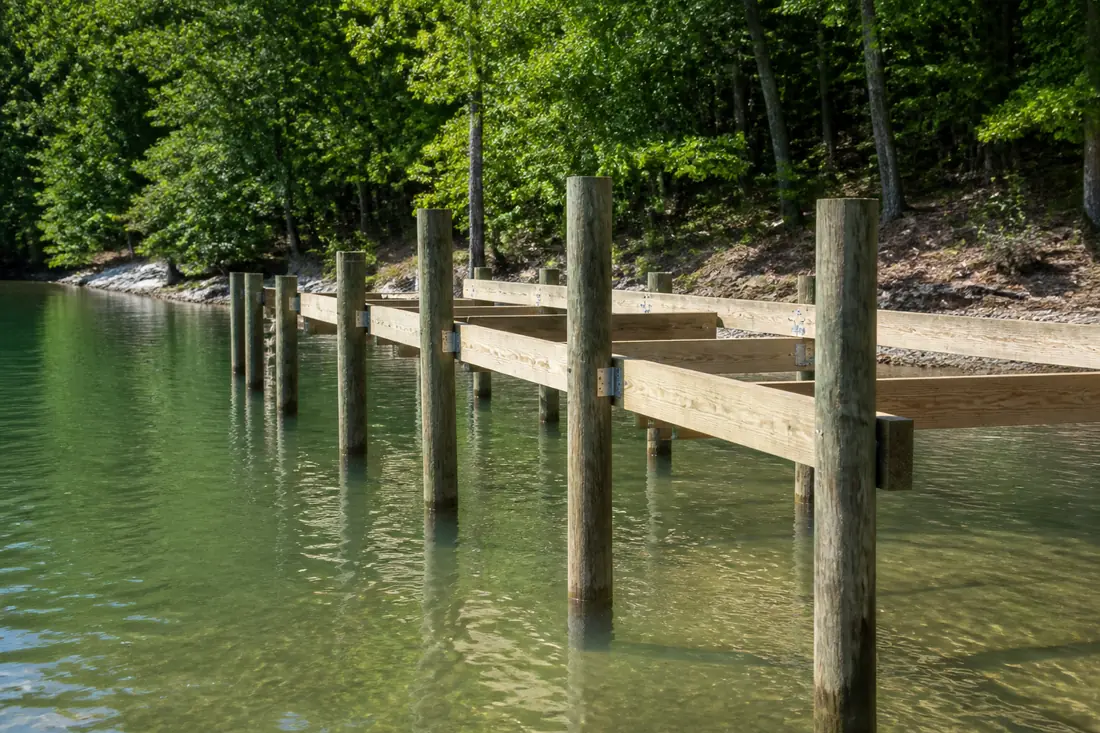
Two piling quotes arrive for the same dock on Norris Lake. Both say “treated pine.” One is materially more expensive than the other, and nothing in either document explains the gap.
The explanation is almost certainly a number neither quote printed. Treated wood is not a single product — it is a species, a preservative, and a retention, and the retention is the amount of preservative left in the wood after treatment. A piling specified for one exposure and a piling specified for a harsher one can come off the same truck, from the same mill, cut from the same tree.
The species is the least interesting part. What decides how long the piling lasts in a lake is what went into it, how deep it went, and how much stayed.
Last reviewed: 17 September 2026 against the USDA Forest Products Laboratory Wood Handbook, General Technical Report FPL-GTR-190, Chapter 15, Wood Preservation, and the International Residential Code, 2018, as adopted for Tennessee.
Retention is a weight per volume, and it has a scale
The Wood Handbook’s Table 15-1 lists typical use categories and retentions for preservatives used in the pressure treatment of Southern Pine, stated in kilograms per cubic meter, with a footnote that converts them: “To convert to retention expressed as lb ft-3, divide these values by 16.0.”
Take CCA, the chromated copper arsenate that is still standard for marine and structural round stock. Along its row the table gives 4 for exterior above-ground horizontal use, then 6.4, then 9.6 and 9.6 for soil or fresh water at increasing severity, and finally 12.8 in the column for piles.
Divide by 16 and those become numbers anybody who has bought treated wood will recognize: 0.25, 0.40, 0.60 and 0.80 pounds per cubic foot.
So the familiar retail retentions are the same scale, read in different units. And the jump from 0.60 to 0.80 is not a marketing tier. It is the difference between the general fresh-water column and the column the table reserves for piles.
Other preservatives run on their own scales. ACQ-C is 6.4 for the general fresh water category and 9.6 at the two more severe levels. CA-C is 2.4 and then 5.0. Comparing a retention figure across two different preservatives tells you almost nothing — 5.0 of one chemistry is not weaker than 9.6 of another. The number only means something alongside the preservative it belongs to.
Use category is what the number is for
The Handbook explains the system the retentions hang from. “The lowest category, Use Category 1 (UC1), is for wood that is used in interior construction and kept dry; UC2 is for interior wood completely protected from the weather but occasionally damp. UC3 is for exterior wood used above ground; UC4 is for wood used in ground contact in exterior applications. UC5 includes applications that place treated wood in contact with seawater and marine borers.”
A Tennessee reservoir is fresh water, so UC5 and its marine-borer chemistry are not the relevant band. The dock lives in UC3 above the water and UC4 where it enters ground or water, and Table 15-1 splits UC4 three ways — general, then severe or critical, then very severe or critical — with piles getting their own column again.
That structure is the whole specification. A framing member on a dock deck, a post socketed into the bank, and a driven piling standing in the lake are three different use categories on the same structure, and buying all three at one retention means either overpaying for the deck or underspecifying the piling.
The Handbook is direct about which error costs more. Its guidance on penetration notes that “even slight penetration has some value, although deeper penetration is highly desirable to avoid exposing untreated wood when checks occur, particularly for important members that are costly to replace.”
A dock piling is the definition of a member that is costly to replace.
Penetration, and why round stock is a harder problem
Retention is not the only variable. Complete penetration of the sapwood “should be the goal in all pressure treatments,” and the Handbook acknowledges that it is not always achievable on large round pieces with thick sapwood, such as poles and piles. Specifications therefore allow a tolerance — AWPA Processing and Treatment Standard T1 for Southern Pine poles requires that 3.5 inches, or 90 percent of the sapwood thickness, be penetrated.
The reason this matters on a dock is checking. Round timber dries and splits along the grain, and a check opens a path into the middle of the piling. If the treated shell is thin, the check reaches untreated wood and the decay starts from the inside, where nobody is looking.
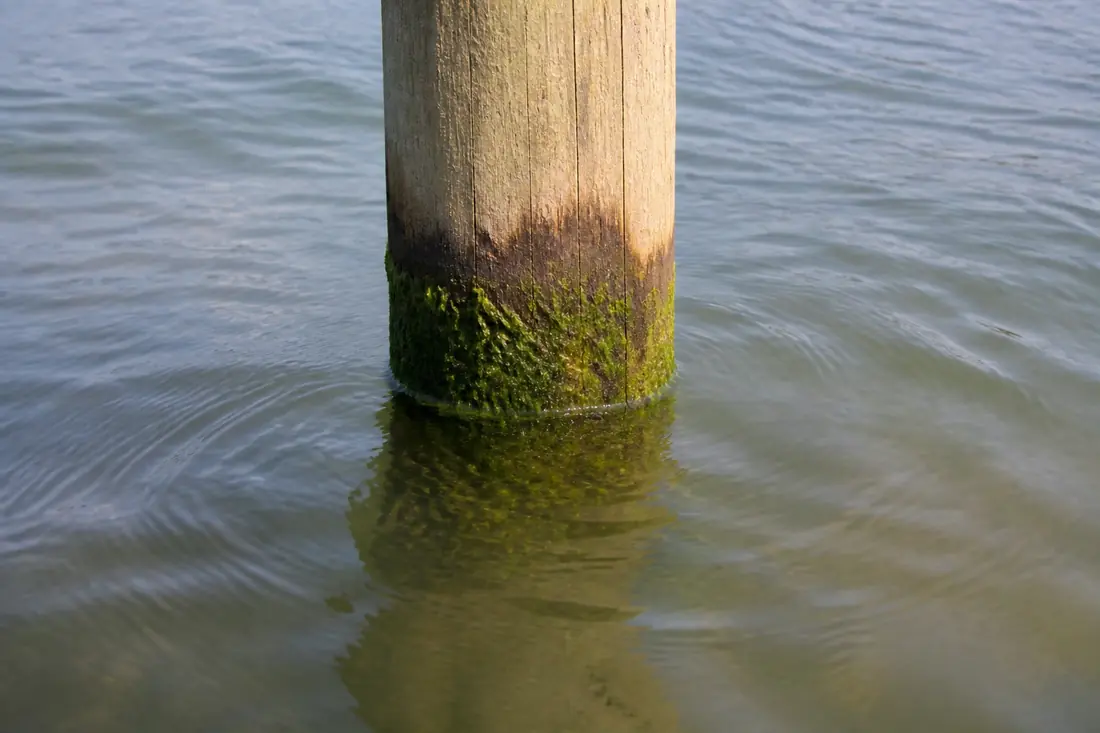
It also explains why the waterline is where pilings fail. The zone that alternates between wet and dry gets the most decay activity, and it is the same zone where checks open widest as the lake level drops through the season.
The end tag is the document
The Wood Handbook is specific about how to verify any of this, and the answer is not a delivery note.
AWPA standards specify how charges of treated wood should be inspected, and the Handbook says inspections are conducted by the treating company and “also should be routinely conducted by independent third-party inspection agencies.” The U.S. Department of Commerce American Lumber Standard Committee accredits those agencies for treated-wood products, and the Handbook states plainly that quality control overview by ALSC-accredited agencies “is preferable to simple treating plant certificates or other claims of conformance made by the producer without inspection by an independent agency.”
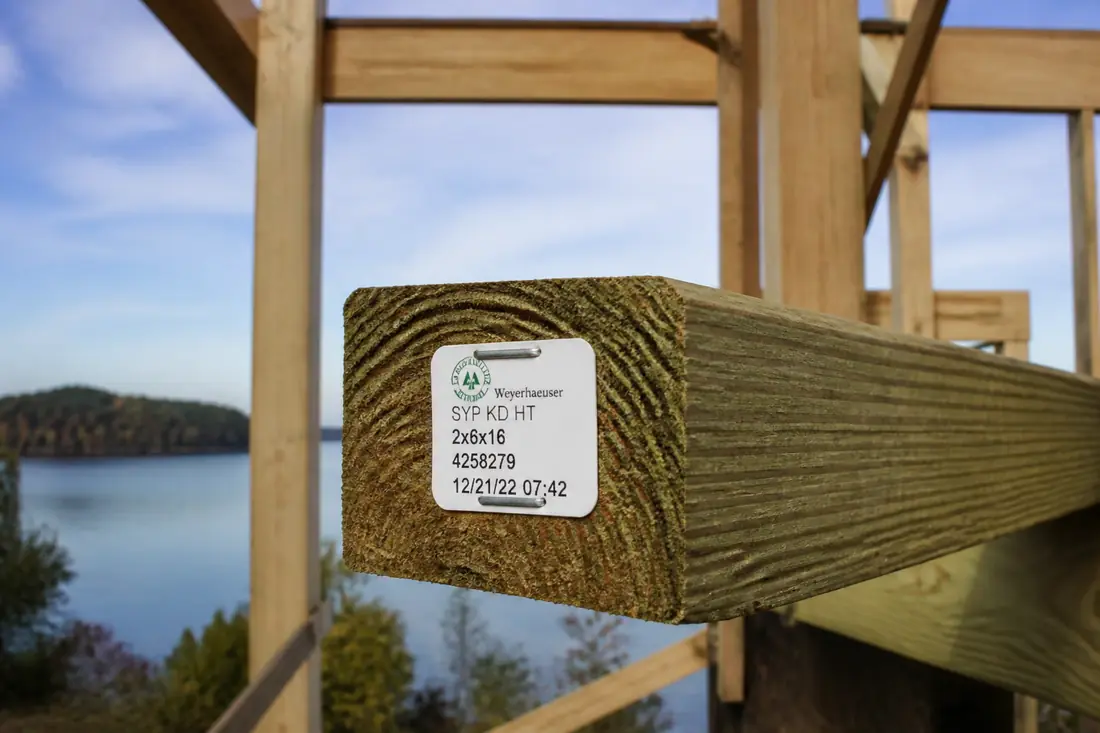
Then the part to take to a delivery: “Each piece of treated wood should be marked with brand, ink stamp, or end-tag that shows the logo of an accredited inspection agency and other information required by AWPA standards. Other important information that should be shown includes the type of preservative, preservative retention, and the intended use category (exposure condition).”
Preservative, retention, use category. Three facts, printed on the piece, on every piece. Walk the delivery and read one.
For critical structures, the Handbook goes further and recommends that purchasers have an independent inspector analyze treated products to ensure compliance — noting that railroad companies, utilities and other large buyers of treated timber usually maintain their own inspection services.
Fasteners are part of the specification
Copper-based preservatives are hard on steel, and the residential code treats the fastener as part of the treated-wood decision rather than a separate purchase.
Section R317.3.1 of the IRC as adopted for Tennessee requires that fasteners, including nuts and washers, for preservative-treated wood “shall be of hot-dipped, zinc-coated galvanized steel, stainless steel, silicon bronze or copper,” with staples of stainless steel. Coating types and weights for connectors follow the connector manufacturer’s recommendations, and in the absence of those, not less than ASTM A653 type G185 zinc-coated galvanized steel or equivalent. Half-inch diameter and larger steel bolts are excepted.
Section R317.3 adds that coating weights for zinc-coated fasteners are in accordance with ASTM A153, and stainless steel driven fasteners with the material requirements of ASTM F1667.
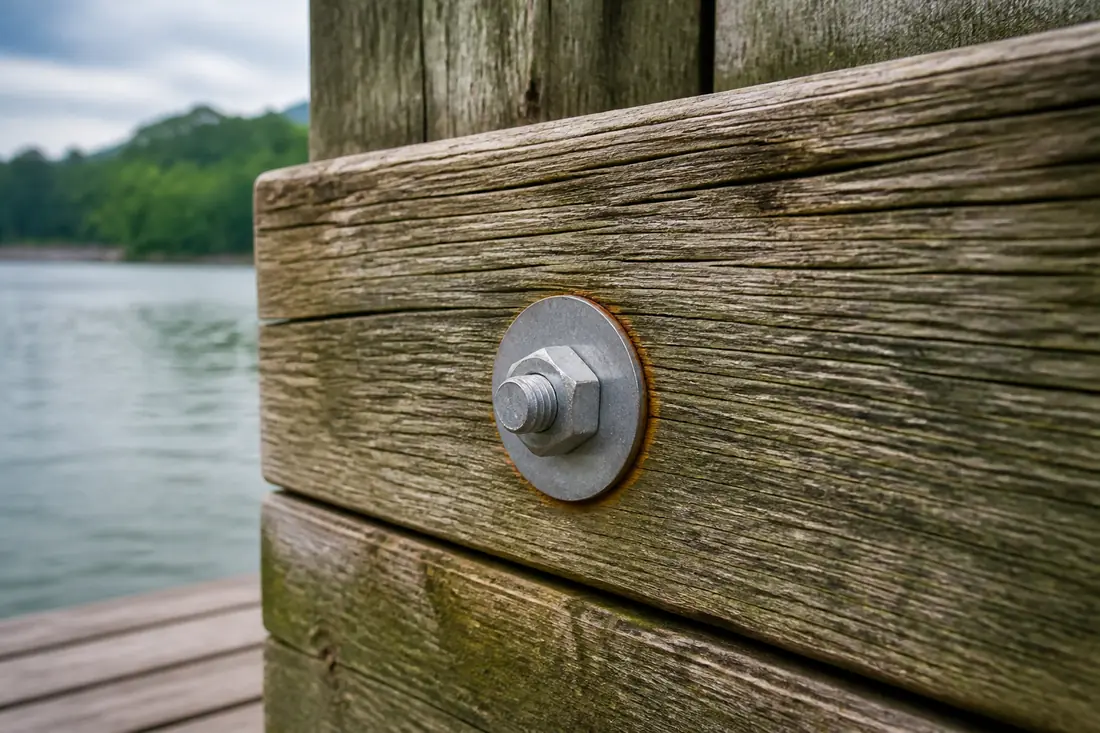
Section R317.1.1 covers the other half of the problem: field-cut ends, notches and drilled holes in preservative-treated wood are treated in the field in accordance with AWPA M4. Every cut and every bolt hole in a dock frame opens untreated wood, and the field treatment is what closes it. It takes a brush and a minute, and it is one of the most commonly skipped steps on a dock build.
What about the lake
It is a fair question and the Handbook answers it in two places.
The EPA consumer information reproduced in the chapter states that treated wood “should not be used where it may come into direct or indirect contact with drinking water, except for uses involving incidental contact such as docks and bridges.” Reservoirs in this region are drinking water sources, and docks are the named exception — but the sentence is worth reading as a limit rather than a blanket permission.
On what actually happens in the sediment, the Handbook reports that research indicates environmental releases from treated wood “do not cause measurable impacts on the abundance or diversity of aquatic invertebrates adjacent to the structures,” that in most cases levels of preservative components were below concentrations expected to affect aquatic life, and that samples with elevated levels tended to be limited to fine sediments beneath stagnant or slow-moving water.
Two practical points follow. Slow, stagnant water is where the effect concentrates, which is an argument for how a dock sits rather than for what it is made of. And the Handbook is equally clear that sawdust and construction debris should be cleaned up and disposed of after construction — the offcuts are a more controllable source than the structure.
What a builder looks at, in order
Where each member sits. Above water, splash zone, or in the water and the bed. Three exposures, three use categories.
The tag on the round stock. Preservative, retention, use category. If the pilings arrive untagged, that is a conversation to have before they are driven, not after.
The checks. How much the timber has dried and split, and whether the shell of treated wood is still intact where it has.
Every cut and hole. Field treatment per AWPA M4, applied at the time, not at the end of the week.
The metal. Hot-dipped galvanized, stainless, silicon bronze or copper, per R317.3.1, and connectors to the manufacturer’s coating recommendation or G185 as the floor.
Repair or replace a piling
Pilings rarely fail all at once, and the decision usually turns on where the damage is.
Decay at the waterline on an otherwise sound piling is sometimes addressable without pulling it. Decay through the core, discovered when a probe goes in easily, is not — and a piling that is soft inside can look entirely normal outside, which is why sounding and probing beat looking.
The thing that pushes the decision towards replacement is the cost of access. The equipment and the water conditions to pull and drive a piling are the same whether you do one or four, so a dock with several marginal pilings is usually cheaper to address in one visit than across three seasons.
What drives the cost
There is no useful price for a piling without knowing the length, the diameter, the retention and use category specified, and how it gets driven at your site. Water depth, bed material and access from the bank move the installed cost far more than the timber does.
The retention difference between a general fresh-water specification and the pile column is real money on a large dock, and it is money spent on the member that is most expensive to replace later. That is the trade to make deliberately rather than by default.
Before you sign
Ask for the retention and use category in writing, per member type — decking, framing, and pilings separately. “Treated” is not a specification.
Ask whether the pilings will arrive with ALSC-accredited agency marks, and keep one tag. It is the only durable record of what went into the lake.
Ask how field cuts will be treated, and with what.
And ask what fasteners and connectors are being used and to what coating standard. On a structure that is bolted rather than nailed, the fasteners are the part that quietly decides how long the frame stays tight.
The sequence that saves money is to settle the use category for each part of the dock before pricing anything. The specification is what the quotes differ on, and until it is written down the quotes are not comparable.
This guide explains published technical guidance and residential code provisions in plain language and is not legal advice or an engineering specification. The AWPA standards in force, the code edition adopted by your jurisdiction, and the requirements of the agency with authority over the shoreline control what is actually required.
Sources
- USDA Forest Products Laboratory, Wood Handbook — Wood as an Engineering Material, General Technical Report FPL-GTR-190, Chapter 15: Wood Preservation
(archived copy;
fpl.fs.usda.govrefuses automated requests). Table 15-1, typical use categories and retentions for Southern Pine, including the CCA row at 4, 6.4, 9.6, 9.6 and 12.8 kilograms per cubic meter and the footnote dividing by 16.0 for pounds per cubic foot; the ACQ-C and CA-C rows; the use category system summary for UC1 through UC5; penetration guidance and the AWPA Standard T1 requirement of 3.5 inches or 90 percent of sapwood thickness for Southern Pine poles; inspection of treatment quality, ALSC-accredited third-party agencies and the end-tag contents; the EPA consumer information on drinking water contact and the docks and bridges exception; and the reported findings on aquatic invertebrates and sediment. - International Residential Code, 2018, Chapter 3 — Building Planning, as adopted for Tennessee. Protection of wood against decay and the reference to AWPA U1 at Section R317.1; field treatment of cut ends, notches and drilled holes to AWPA M4 at Section R317.1.1; ground contact at Section R317.1.2; fasteners and connectors in contact with preservative-treated wood, ASTM A153 and ASTM F1667 at Section R317.3; and the permitted fastener materials, stainless staples, the ASTM A653 type G185 default and the half-inch bolt exception at Section R317.3.1.